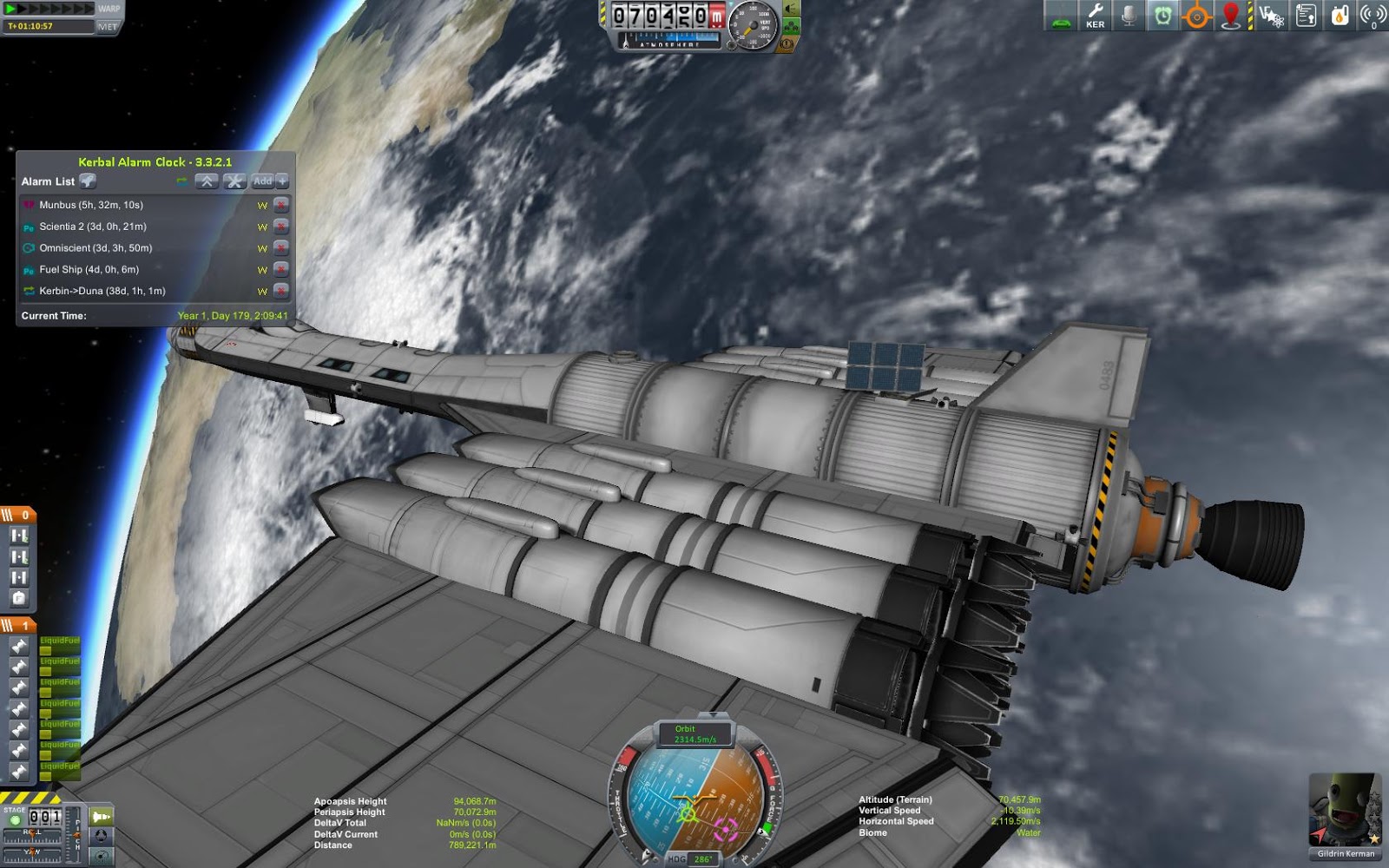
Flieger, grüß' mir die Sonne, grüß' mir die Sterne und grüß' mir den Mond. Dein Leben, das ist ein Schweben, durch die Ferne, die keiner bewohnt! - Hans Albers, F.P.1 antwortet nicht (Adaptation in the 80s: Extrabreit)

Monday, 27 July 2015

Design of a Yawl

While I just could get ahead with my numerous space expeditions, something still bugs me. The dinghys which I was able to design so far can only transport one passenger. This must be a scientist, so that I can reuse all that scientific equipment. But what if a wheel blows up? I can compensate for only one, by substituting with the landing gear. It would be better if my dinghy had room for two or more crew, so that an engineer can be on board, as well, to repair that wheel or to pack parachutes (concerning the Duna landing).

So I get distracted again and spend one and a half game sessions in the VAB.


- Calamari Lander


Ok, this thing can carry a crew of four and has all scientific stuff on board. I do not worry too much about its mass, the Navitas can afford it. Special about it is the vertically aligned Spark engines. The ore dish is only for balance purpose. And it makes it look like a calamari. Hm, not sure if I like this design.

In between, there are some routine maneuvers, namely, the third pass of both the Fuel Ship and the Scientia 2 for their aerobraking.


- correcting orbital angle to an equatorial one


- how many more passes do I need, I wonder ...


- ... but my Kerbonaut here has fun


Then back to my unfinished design. It also gets some parachutes added, for a fuel-saving Duna landing later on. I want to test if the vessel is capable to land like this. So I add a launch stage for about 70,000 credits, launch, and then stage it at about 4,000 meters. The parachutes work very well, the vessel lands like a feather and does a qualifying test parcours around the Space Center.

Then my mistake: Instead of reverting the flight, I recover the rover, as I used to do during my past tests of the Crab Rover et alia. The moment I press that button, I realise my mistake, but too late; 70,000 Credits are blown out of the window. Dang! This is a little taste of how frustrating the game would be on hard mode, where every little mistake can blow your finances and thus ultimately make you fail your career due to lack of finances.

A little adaptation, making the vessel not really look a calamari anymore, and I want to do a test orbit and de-orbit with my new design. Since this is a kind of picture story again, let me test how linking this one to an imgur account works out:

View post on imgur.com

Uhm. Not very well. Anyways.


- Yawl


The main problem seems to be the wrongly aligned navball, making it difficult to find the proper direction, especially when trying to line up to a maneuver node. This is due to the SAS unit facing forwards instead of upwards, to account for the vertical trust vector instead of the normal, horizontal one. Hm, maybe using the one manned Crab Lander would still be the better idea? Not sure; it is the crappy thrust of its Terrier engine when in an atmosphere, which bothers me. After all, I want to land on Duna and be able to take off again.


- the Crab Lander´s TWR doen´t look too good on Duna

In comparision, the four Spark engines which I chose for the Yawl are going to produce much more reliable thrust in Duna´s atmosphere.


 - after some little tweaks, still not really as elegant as I hoped, but the thrust is acceptable

So, it is time for another test run on Mün, I suppose. Launch almost goes wrong, when the rocket suddenly flips at about 20km altitude. I manage to regain control, but at the cost of having only 500m/s deltaV left in orbit, compared to the 1500m/s which it should have left over.

Then I realize another mishap; one rover wheel has blown. Since I do not have any engineer at the required experience level, I cannot repair it during an expedition and thus my test flight already failed. I wonder how this could have happened. After a reload, the case becomes clear; my latest design tweaks had caused a rover wheel to clip through the fairing. However, this gives me the occasion to not only correct the fairing´s shape, but also to add a docking port on the top. Like this, I can switch the nav ball´s perspective of control from the usual horizontal view to a vertically aligned view, by clicking on the docking port and choosing the option "control from here". I learned this in one of the many gameplay videos. Also, the closer the point of control is to the center of mass, the less erratic the SAS seems to be.

Launch goes well this time, I manage a remotely fine gravity turn. Once in orbit, I plot an intercept in order to fuel the Yawl up again. Then I am going to send it to Mün orbit, dock to the Scientia to take over some crew and then do some landings with both the Yawl and the Crab, to compare their actual performance.


 - the Yawl is in orbit, and on intercept to the Fuel Dragon


Real life does not let me have the time I want, so I logout and resign to write about what little progress I achieved during those meager two game sessions since my last blog entry.


Friday, 24 July 2015

A nice combined satelite deployment & rescue mission


The mission control center offers two new contracts. A simple satelite deployment and a rescue mission in low Kerbin orbit. I can neatly combine them by using my cargo shuttle. Since there is not much else happening in this particular game session, here is just a little picture story about it. I think the value is in documenting that a routine mission can actually unwind flawlessly. A rare event...


A satelite plus a rescue contract in a perfect combination for a spaceplane launch system, my cargo shuttle.
The cargo shuttle´s ascend, phase 1. Phase 2 starts at about 9 km, by dropping the angle of attack down to 8 degrees.

Ascend, phase 3; fire rocket engines once speed starts to drop (~18km altitude), adjust angle of attack between 10-20 degrees. The goal is to achieve your target apoapsis at the same time as you achieve orbital speed (2300 m/s). Too low angle means an inefficient late apoapsis, too high requires a longer more inefficent burn for the final orbital insertion. Shut down jets and air intakes at 24 km altitude.


Orbit achieved; the cargo shuttle can carry two satelites, just in case.

The red orbit is the satelite´s destination; the yellow orbit is that of the stranded Kerbonaut. On the lower right, you see the rendez-vous point with only 1km distance, which I achieved by using a prograde and radial vector to adapt the cargo shuttle´s orbit.

After the Kerbonaut is rescued (her wreck is still targeted in the background), the satelite gets deployed.

Some simple maneuvers to get it to the target orbit. First match periapsis, then orbital angle, then finalize by raising apoapsis.

Cargo shuttle re-entry. Pump fuel to front tanks for a forward center of mass. Drop periapsis to 10km at about a quarter of Kerbin ahead of the landing area. Use airbrakes only for adjustment of your cours towards the landing area, or when heating up too much between 20-40 km; does not happen here when I keep prograde (later, when under 15km, keep horizontal).

I think I finally found inspiration for a name for the cargo shuttle; Firebird!

Touchdown! A arrive at the final approach often too high and thus slow down and glide until touchdown. Pump fuel back from front tanks to aft tanks for (better) maneuverability at low speeds.


Wednesday, 22 July 2015

Omniscient in solar orbit, Navitas entering service

The busy days are finally there. Before the Scientia 2 and the Fuel Ship enter their second aerobraking pass, the Omniscient finally has reached solar orbit. Six more mission contract goals are checked.


- all the busy conics within Kerbin SOI look now very small


If it just wasn´t for that one darn tourist who wants a solar suborbit! After some more tries to find an efficient maneuver node, the cheapest one I found is a retrograde ejection from Kerbin at about 6,000m/s deltaV. I also asked and got confirmed in the game forum that the sun´s suborbit starts at below 600 km. Ok, at least that means that I can construct a capsule-only vessel with a nuclear engine which is able to pull this off without actually having to travel there for years and/or use slinghots on the way.

After some musing if there is anything else for the Omniscient to do in this solar orbit, and, no, there isn´t, it needs to be sent back to Kerbin. To my surprise, while the deltaV to do so initially is shown as an acceptable 390 m/s, the travel time back to Kerbin is about 16 days! This is almost double the amount I estimated, considering that the travel time to the very outward-situated Minmus was only 8 days. On top, something then goes wrong during the maneuver and the trajectory has surface contact with Kerbin. Reversing it by a little bit pulls my trajectory again out of Kerbin SOI. Redo. Somehow, I cannot seem to get a trajectory which does not touch Kerbin´s surface. So I decide to do a two-step maneuver, to first get into Kerbin SOI, and only then manipulate my trajectory further.


 - getting back "in"


On step two, a litte surprise happens; Mün intersects and helps me getting back up to an orbital trajectory with much lesser deltaV. At least, such is the theory. The conics seem to be pretty unreliable sometimes; I will have to closely guard this flight!


- interesting course, Mün seems to help me saving some deltaV; however the data on my periapsis still says -321,000km


The orbital angle is very crappy, though, and will cost a lot of deltaV to correct. I am not sure what I can achieve with the remaining amount of the Omniscient.

After the Omniscient maneuvered what it could maneuver, the Fuel Ship enters its second aerobraking phase.


- a streak across the dark sky


Before I timewarp any further, I just wonder why on earth I wait for more science points when I could already transmit them from my various vessels!? What I overlooked and realize now while clicking through all the science out there, EVA and crew reports can be transmitted at full science value and they still remain stored and can be processed for the Mobile Lab. I really wonder why I did not realize this until now! Like this, I am able to open two more 160-point tech nodes; one for large reaction wheels, one for large landing struts.


I think that there is enough parts available to finalize my new mothership, the Navitas. Anything else from now on would probably lead me away from my current ship classes, opening up totally new designs.


- there is all the stuff I need for my current Mk-2 ship classes


It is time now to finalize and launch the Navitas, an evolved Omniscient-class mothership. Large reaction wheels should reduce the terrible clumsiness which the Omniscient has to deal with. The large landing struts should allow a safer landing, without having to risk to blow away the engines if the ship sets down too hard.

Since I designed it based on the Omniscient file, I use the same launcher stage setup. Unsucessfully, I must realize.


 - blows up even before lift off!


While the launch of the Omniscient was also a hazzle to figure out, I clearly not remember something like this;


- the entire structure of the launch stage is super wobbly


 Did the game mechanics change and make some parts more wobbly? On top, the ship rotates and I can barely control this manually, thereby very easily sending the vessel off-trajectory. Even after learning how to closely guard the self-rotation, having finally reached some altitude, the next problem appears;


- staging the boosters, they collide and destroy my mid stage


After all these unsuccessful tries, I am pretty sure that the game did not behave like this when I launched the Omniscient. This is painfully embarassing; the reload button gets heavily abused. After almost the full game session consisting of reconfiguring the launch stage, I finally find the culprit: The struts. I needed just one additional long strut which stabilises the mess on the downwards section. No more wobbly, no more collision while staging the boosters. I am not sure I like this behaviour of the game; it seems to be caused less by the intended simulation and more by random wobbly part behaviour.


- the Navitas finally achieves orbit and burns for Minmus


My first plan is to refill the Navitas via the Fuel Dragon, which is still ready in LKO with a considerable amount of fuel. However, I also wanted to use its fuel for the Scientia 2 and the Fuel Ship. Since the purpose of the Navitas´ virgin flight is to test its mining setup, in the end I dare to send it immediately onwards to Minmus, with only 1024m/s deltaV left after the ejection burn.


- I am pretty much proud of this vessel


This basically means that the Navitas has probably barely the deltaV left to land and launch again into Minmus orbit; in order to return to Kerbin, this mining-thing has to succeed. And if it does succeed, I will happily launch the Navitas towards Duna as soon as possible. Being able to resource itself with fuel, I even can use up most of its fuel for a high energy transfer, thereby saving a lot of travel time.

This unexpected early launch of the Navitas also means that my Münbus/Tripol expedition to Minmus might have lost some significance. But I can still use the smaller and thus more efficient lander to cover a touchdown at all biomes. Actually, the Navitas is perfectly suited to complement this expedition, by providing the fuel for any additional landing on Minmus. I think I will have a lot of science points incoming after this venture has passed. The Navitas currently runs un-manned, so the crew from the Münbus/Tripol should be very happy to be provided with such a luxurious base of operations. The Navitas did a high-energy burn towards Minmus, thereby arriving even before the Münbus/Tripol.

However, because the launch the Navitas used up so much time, my game session already has to end here.


Saturday, 18 July 2015

Plans proceed slowly

My first exercise in this game session is to bring the Cargo Shuttle, which has brought up and deployed my satelite with the new ore scanner, ScanSat, now safely back to Kerbin. This should be a routine, except for that routine can make you fail pretty quickly, especially in the Kerbal Space Program!


My usually successful approach is to aim for a flat entry angle, by dipping my periapsis down to 15km, with the Space Center being roughly half way between the vessel and its new low periapsis. Depending how well I control my angle of attack and the airbrakes (and the landing gear, which also produces extra drag), I land moreless accurately on the same continent. Thanks to the adjusted drag mechanics of patch 1.04, my airplane can remain very long periods at supersonic speed. This allows me to even more fine tune my destination, by just not having to use the airbrakes so often.


- all systems nominal; yet


Then this little accident happens. I arrive a bit to high for a direct landing and want to dip a bit down. Thanks to this fabulous bad SAS game mechanic and a half-a-second too long tab on the key, my plane oversteers and dips a bit too deep.


- supersonic discombombulation


Remind me to first get below transsonic speed before I start to fiddle some maneuvers! As the drag forces shear my spaceplane apart, the front part remains intact, and my pilot still grins manically. So, let him do this stunt!


 - Cargo Shuttle, uh, front-part, requests, uh, permission to land!


Torque is sufficient to bring the weck into a horizontal position. To further slow down descent, I open the cargo bay doors and hope that they actually have drag and thus airbrake a little bit, too. Well, what can I say, it seems to work out!


- any landing you can walk away from...


This stunt was so cool that I really want to leave it at that and ignore the reload button. However, my finances are stretched thin since I upgraded the science buildings to the max level. Only 220,000 credits are left, and I really do need 280,000 soon. Because the sister ship of the Omniscient will soon be ready for launch, and it is that expensive indeed. And this financial difference is manifest in the Cargo Shuttle. The scedule is very tight for the upcoming transfer window and new short-term missions for a quick cash grab are not available.


So I do reload that re-entry attempt, just to realize that I forgot to do a timely quicksave. Which means, I have to play through the deployment of the ScanSat again, thank god at least the Cargo Shuttle was already in LKO on my last quicksave. All goes well this second time.


 - another one of the frequent déjà vues, aka, reloads


After this little episode, I switch to the Münbus/Tripol and collect gravtiy data for each biome in high kerbin orbit. The elliptic trajectory makes even small spots like the occasional mountain area stay under the ship for long enough so that I can send my scientist on EVA and collect triple data and store it in each pod. This is again 27 science each for the shore, water, grassland, highland, mountain and desert biomes. With some luck even catch two tundra measurements. There are also badlands somewhere, but they are elusive.


- my scientist on the Mübus/Tripol is busy with gravity measurements


I am now waiting for the "busy" period. I could already launch now my new prototype mothership. This one has all new tech on board, which I did not have access to yet when I built the Omniscient. This should be a truly independent interplanetary spacecraft, being able to mine ore with two drills and convert it into fuel with the ISRU converter. According to the TWR data , it should be able to land and launch both on Duna and its moon Ike. It also has aboard the ore and the surface scanner; unfortunately, the last gadget, a narrow-band scanner, is locked behind a 1000-point tech node. But since I do not aim for a specialized mining operation and will have plenty of time over there at Duna until a new transfer window comes up, I will not need a hyper-efficient mining location, anyways.


- the Navitas entering final design


By now, the Scientia 2 is sceduled to arrive in a bit more than one day; it will bring a host of Minmus scientific data, about 700 points iirc. Based on my experience with the Omniscient, the most urgent thing to unlock are the large reaction wheels, so that a 180-degree turn might take not as long as a minute to complete anymore. I also would like to finally unlock and add normal-sized docking ports. This new expensive ship should be a little bit future-proof.

The Navitas, as it will be called, will serve me to cash-in two lucrative mission contracts: Collecting ore from Minmus, putting a station with at least space for 9 crew into Minmus orbit; there is also a flag-plant mission and a science-collection mission, but those will be done by the Tripol. I might want to combine the missions and use the Navitas as refilling point, as it will be shock full of fuel and is going to mine for even more fuel.

In an afterthought, I also add a little satelite with a surface scanning module on a docking port; this equipment was unlocked after the Tripol had launched; in fact, it was unlocked with the first batch of science which the Tripol had collected and was brought home by the White Goose. Since the Tripol will be the vessel to visit all Minmus biomes, it practically must have this one more toy on board! I will try to attach it on the Tripol on its docking port. This will be a bit of a hazzle, as I have to redo this every time when I need to refuel, but what can I do at this point.

If my Minmus operation with the Navitas turns out to be a successful test, I will use this vessel instead of the Omniscient for the Duna expedition. If the test of the Crab Rover over at Mün is also successful, this will be its dinghy. For all its crew to get the experience from a Duna flag exercise, the Navitas should be able to land by itself. The Crab Rover can efficiently cover any additional observation mission contracts, current and future ones. In the meanwhile, the Omniscient can stay in Kerbin LKO and serve as a space station and refueling point.

So far my plans, but, alas, my scedule gets destroyed, respectively turns out to not be as I wanted it to be. The Scientia 2 arrives, sure, but with 3,300m/s and only 530m/s deltaV in its tanks and thus needs at least two more days for another roundabout, aerobraking. Its first round brings the apoapsis down from 44 mio km to 10 mio km.


- a hot affair, but a periapsis of 45km turns out to be still fine for a speed of 3300m/s


In the meanwhile, while checking for more biomes to take measurements from, the Münbus/Tripol  looses its course on Minmus SOI multiple times and is vibrating; I guess the bug attached to the small service bay is still around. Now I know again why I had left that ship in Kerbin LKO! I probably should put it out of service.


- on top, there is another bug; I cannot add a maneuver node anymore on the blue conic


As it is a weekend late night/morning, my concentration is low and I get the feeling things are going to get worse if I go on. Let´s see how things turn out on the dawn of a next game session.


Friday, 17 July 2015

Some more Minmus launches

For some time, I read a bit about the mathematical background of rocketeering. In an earlier blog entry back in April, I already tried to get a grasp what the figure of "deltaV" is about. During my extensive design, I always wondered, how can I eyeball a bit better what engines and the amount of fuel is needed in order to reach a given target with a given payload.

I took some of my questions into the game forum and got some helpful tips, which I translated into a spreadsheet. I also got the hint that a somewhat interesting youtube-gamer made a very nice video to connect the player of Kerbal Space Programme back to good old school physics. Basically, it is about being able to roughly plan which engines and how much fuel you have to take with you if you want to bring a certain payload mass to somewhere else, the distance to be covered being expressed in a deltaV figure (because, if I understand this stuff correctly, in space, traversing a distance is more about achieving a different level of kinetic energy or speed, in relation to the local dominating gravity wells i.e. big chunks of matter i.e. planets and moons and rocks).

After having found the correct formulas and playing around with the spreadsheet, I find that it gives me a good idea about relations, but I am not playing that precise enough to really design a ship by a spreadsheet.
I guess the most useful aspect for me is going to be to estimate when a switch from a conventional engine to a nuclear or ion engine, once I have them available, would make sense. In all other cases, I do not really need a precise calculation; my main "fault" so far has been that I misestimated the deltaV requirements, so I try now to overengineer my vessels, anyways.

Back to Kerbin. It is t-2 days towards "busy day". And again, I have discovered plenty of additional occasions, so again nono to timewarp, and here is a little picture story instead, which is mainly about the launch of some Minmus focused operations.


- the Münbus docked with the White Goose for refuel, then with the Tripol, and is now burning for Minmus (forgot to refill the monopropellant, but still 50% capacity will hopefully do)


- an eternal burn for Minmus of 8 minutes, due to only 0.25 TWR of the combined vessel; there is probably not enough dV left, so it is better to just do a flyby and drop off the Tripod


 - the White Goose V2 has taken over some science points from the Tripol (the LKO gravity measurements)


It is now time to try to get the White Goose V2 back on Kerbin; the problem still is that I forgot to install airbrakes. In order to compensate, I pump all fuel to the frontal tanks. I want to try to brake by flying an upward angle of attack, but this requires a forward center of mass, lest the plane would easily flip over at those high speeds.


-  re-entry without airbrakes thankfully works out


The re-entry works out in the end, but still not as planned or anticipated. My electricity runs out while I try to keep an air-braking angle of attack ("AoA", a cautious +10 degrees to prevent it from flipping over). Thanks to my forward center of mass, the plane continues to fly prograde all by itself. Then, thankfully, the turbo engines kick back online without needing charge and they produce sufficient electricity to regain control. So, in the end, the plane survived the high re-entry speed even without needing airbrakes or my "high angle of attack" steering. I guess I am lucky that the Kerbal Space Programm goes very easy on the player rooky with its atmosphere flight mechanics.

A second tense situation arises during the final landing approach. I almost crashed when I approached too high and dipped my AoA to -25 degrees; the control surface could not handle re-aligning to 0 degrees. During the last seconds, I remembered and managed to pump all fuel from the front tanks to the aft tanks; this kind of trimming shifted the center of mass backwards enough for my control surfaces to get a grip again.


- very glad to have made it; bringing back 108 science points and some unused fuel


My science point account now alows me to unlock the 300-point tech node for the ore scanner. I feel that I should test that thing and probably bring it then along to my Duna mission. Which means that I should quickly prepare according missions, lest the launch window to Duna is gone. So, I construct a satelite with that hughe dish on it. There is no good way to maintain an upwards mounted docking port, so I will have to think about a different way to transport this satelite. But for now, I only want to launch and test a basic setup.


- the Ore Scan Sat fits barely into the Cargo Shuttle´s bay...


With no more room for docking clamps, ejection is going to be done via a small separator, even when there is no room to really get pushed foward. I hope that the game mechanics will be forgiving. As a sideline, I also adapt the Cargo Shuttle´s engines and wings to patch 1.03´s modified atmospheric model. It flew well already, but it had still the old 150-fuel tanks instead of the revamped 400-fuel tanks.


 - moment before the moment of truth


Thankfully, the ScanSat survives the harsh forces and clips harmlessly out of the Cargo Shuttle.


- cannot scan unless in polar orbit; good that I tested this and found out before plotting an orbit for Minmus


The ScanSat is ready to leave for Minmus... until I discover that I forgot to put a regular antenna on it, too (that big dish is only for ore scanning, after all!). Reloading the whole launch (which I find myself doing quote too often it seems!), then finally the emptied Cargo Shuttle is ready for re-entry and the ScanSat burns for Minmus.


- ready to leave the scene


This ends a very Kerbal typical game session, a lucky one, because only one re-load was needed for that forgotten antenna, and I even avoided a near-crash of the White Goose V2.

Next session, I hope to complete and to detail a bit more my new ideas concerning the Minmus missions.


Thursday, 16 July 2015

Setting up side missions

A big bustle is going to start in my Kerbal Space Programme in about three in-game days: the Omniscient will have finally exited the Kerbin SOI; the Scientia 2 is going to finally be back from its Minmus operation and bringing home a filled Mobile Lab and about 700 science points; the Fuel Ship is going to arrive for a refill, being sceduled to bring that fuel to the Scientia and the Crab Rover in Mün orbit.

The mission control center currently has no new contracts to offer. As my mouse pointer hovers over the time warp button, I hesitate. About 38 days are left until the Duna transfer window is open; have I started all possible science expeditions within Kerbin SOI? They would need to finish still in time to be able to contribute to the Duna expedition. In order to reap science from Mün, the "Lander R Buggy" has been placed there (wtf, sometimes my naming ideas are really crappy! let´s call it rather "Crab Rover" from now on!); in about five days, it will be refilled and ready for action. What about already visited biomes elsewhere, for my latest science experiments, the atmospheric and seismic and gravity instruments?

Since I feel like flying once more an airplane, anyways, I decide to pay a visit to the desert+mountain and arctic+tundra biomes on Kerbin; these pairs are in vicinity and could be covered by one flight and landing each (shore, grassland and highlands I did already cover). With the changes by patch 1.03, it is easy to achieve about 1050m/s at 13 km altitude, causing temperature gauges shifting into the reddish spectrum, so faster I do not dare to go during my extended flight. What I also do is to replace my little drones on both ends of the runway and replace them with flags, planted by a Kerbonaut; this way, my list in the tracking station is not getting cluttered with these inactive vessels.


- this will turn into a déjà vu

Three or four crashes later on my landing attempts in a desert area, I realize that the wing lift ratio might have become a bit too little after the revamp, if you need an airspeed of >150m/s in order to be able to float towards touchdown at the required <~10m/s vertical speed. This is too fast for me to handle a proper touchdown on an uneven landscape. Even after switching to two Mk2 delta-wings, landing speed still needs to be ~120m/s, but I finally manage those landings.

From the desert landing spot, it is just some "driving" until I can reap science also from a mountain biome. For the tundra and arctic biome, I need only a short hop. My science account receives 70 science points from each flight, those are from the new advanced experiments concerning gravimetric, seismic and atmosphere measurements.


- little hop between an arctic and tundra biome


Altogether now 180 science points on my science account would allow me to open another tech node, but I am not sure which one. I think I should aim to first open the ore scanner, in order to find good spots to mine ore; 300 points are required for this.

The scientific exploration of Minmus is still quite open. I could re-send the Scientia 2 there, letting it land by itself again as I did once already or just dock a lander, which will also have all latest science experiments on board. But I could also build a more efficient lander and already send it now, three to four days in advance before the Scientia 2 arrives and can be restocked at Kerbin. Briefly remembering my "Twin pod" Lander prototype, for having multiple copies of scientific data, I rather want a "three pod" lander: One data copy for upload in any Mobile Lab it docks to, one copy to bring back to Kerbin, one copy to transfer to the Omniscient´s Mobile Lab in order to have "food" for during the long voyage to Duna.

For some time, I try to construct a spaceplane which is capable to fly to Minmus and do multiple landings there. However, after about a game session´s time of trying to set one up, I give up for the time being. I probably need to wait until I have opened more tech nodes, e.g. the one with the ultimate RAPIER engines, in order to pull this one off in an efficient way.


And thus, a rather conventional Triple Pod Lander ("Tripol") gets designed and manned by my last three remaining Kerbonauts; the rest of them are all distributed on my operations in space. Besides, letting those rookies "flag" Minmus, which coincidentally is also a mission contract in my books, will be doing good to their experience level. The Tripol´s deltaV potential is high enough to reach Minmus all by its own and do some landings, but as I want a maximum available deltaV for multiple landings on all biomes, it would be good to combine it with the deltaV reserves of the Münbus, which now has floated in LKO for quite some time without having a "real job", apart from occasional LKO rescue contracts.


- Tripol in LKO; of course I had forgotten to add solar panels on my first try...


Of course, this new Minmus expedition is a bit redundant, as I could have gone to Minmus, as originally planned, only with the Scientia 2 again. But like this, I save some time and will have science from Minmus back faster, and the Scientia 2 could then just stay in "space station mode" in Minmus orbit, with the Münbus/Tripol independly doing the landing and courier service.

While the Tripol approaches its docking destination, the gravity detector gives me new science points over each biome and put that data into the three cockpits each, so I have three sets of 6 data already.

I also spend some time thinking about that darn tourist, who wants his suborbital flight to the sun. If I had a nuclear engine plus twelve fuel tanks at 400 units each, I could scrap together a capsule-only ship with about 12,500 deltaV (and a very weak TWR of 0.2). I guess only an ion engine setup could get a higher deltaV potential. However, a direct retrograde burn to achieve suborbit is 7500m/s, so the equally expensive quick return trip would still not be secured. I will have to experiment a bit more with maneuver nodes, there must be a "cheaper" way to achieve a travel itinerary.


 - long range Tourist capsule?


And, whoops, again time has passed. On my third game session since my last blog entry, after launching and docking the Tripol to the White Goose for a refuel in LKO, as well as transferring one set of science points for a quick retrieval via the White Goose, I log out, with the next steps planned as follows:
- Dock Münbus with Tripol at White Goose, burn for Minmus.
- Finally time warp to the innitially mentioned "big bustle".


- refuel and some more spaceous crew cabins while waiting for the Münbus to join in

Monday, 13 July 2015

More design and concepts

Some more dire needed holiday has passed, the weather was perfect. Back in a solar system far, far away, on a small planet called Kerbin: The Kerbal Space Programme continues under avoidance of the the time warp button. As such, the Crab Rover arrives at Mun and docks with the Scientia, but cannot venture further without a refuel. Travel times of all current operations in space, including my Fuel Ship, are still measured in days, and those days can be used to revamp some pivotal ship designs.


First, the White Goose class. Needs more engines in order to achieve higher atmospheric speeds, in order to benefit from the changes from patch 1.03/1.04, namely being able to achieve and hold high mach 4+ speeds longer before melting from thermic shock. Since the space foreseen for the engine nascelles is to small to accomodate another pair, I redesign the entire wing structure. Which proves for quite a challenge. So far, I just had clipped the engine in the wing structure. Now, I tack the enginges to the wing root and then tack on the rest of the wing. The results are majorly different. Wing stability goes haywire, I have wings like a wet lasagne noodle. 


 - very flappy wings


Several tries to stabilize this mess by means of struts make me discover another vital fact: Struts seem to be more stable the longer they are or the more triangulat-y the strut-angle is. Several small struts between the engine nascelles and the wings did not help, whereas one long pair of stuts to the outer nascelle suddenly makes the wing stiff as never before.


- also, only one jet nascelle and some additional fuel in the engine nascelles


The final result is pleasing: The new White Goose "V2" achieves orbit with almost double the amount of fuel than before left as a payload!

Emboldened, I then also test the Fuel Dragon a first time after patch 1.03/1.04. It still runs fine with just a little tweak to the engine nascelles like I did with the White Goose, although it of course now accelerates much slower than before. But there is no need to adapt its design: Likewise, it has almost double the fuel payload available for transfer in orbit! This means that the chore of refilling my flagship, the Omniscient, will be halved, from roughly ten flights down to five.


- Fuel Dragon, with an amazing amount of fuel payload


Once both spaceplanes are in orbit, I realize a mistake: I forgot the airbrakes on the White Goose V2. Oops. The point to reload the flight has long since passed. Hopefully it will still be able to sufficiently slow down during re-entry. But, since the fuel is in orbit, I want to wait until I have refilled something before doing that re-entry.

Since I do not really have a lot of time available for my game sessions, they continue to consist of little fixes and tries on construction.


- my old Swan Lander design from beta0.9, finally revamped


A basic mining rigg, just to see how it works. A driveable mining rigg, to find the best spot on the ground, once I have the tech node for the surface scanner unlocked.


 - let´s call it a concept drillcar


I also wonder about where to set up the ore converter (ISRU): On the ground together with the ore, or just bring the ore to an orbital ISRU+fuel tanks? There are quite some discussions in the game forums on which setup works more efficiently, and where. Thinking and conceptualizing, I in the end come to ask myself; why would I need such a mining outpost? My spaceplanes are much more faster, flexible and right at Kerbin, which is the better place for launching new operations, anyways. Should I bring a mining vessel along to Duna, docked to the Omniscient? Then, an idea dawns: Why should I have a seperate mining vessel at all? The Omniscient already did prove that it could handle a low-gravity landing. It has huge fuel tanks; what if I replaced one 1440-fuel tank with an ISRU and just add an ore container and a drill? In relation to its total mass, it would only add little more encumbrance and I would have a truly self-sufficient and thus independent interplanetary space craft.


 - a possible new Omiscient-class prototype with self-refueling capacity


Maybe a this revamped version of my flagship could get ready before the Duna transfer window is open? I also should probably look and see how much science I can still reap until then from missions to Mün and Minmus, to have the latest and best tech built into this second version of my flagship.